
2026 Big Ten Schedule Analysis
Ranking all 18 teams' schedules from easiest to toughest.

While we’re still months away from playing games on the field, it’s never too early to take a look at the docket for 2026! Join the Three Tech as we take a deep dive into the easiest and toughest schedules in the power conferences, beginning with the Big Ten.
Say a prayer or send a note to your local Big Ten schedule maker.
The headaches associated with creating a schedule for an 18-team league, especially one with a varying number of protected rivalry games for each program, would make one yearn for the allergies associated with Cedar Fever. Nevertheless, the realities associated with college football’s largest conference, as well as all division-less mega-conferences, bring about a natural imbalance in the schedule.
If the first two years of an expanded playoff have taught us anything, it’s that who you play, or maybe more accurately, who you avoid playing, are sometimes just as important as the talent level and returning production when making preseason prognostications and playoff predictions. With a conference slate that includes only half of the teams in the league, there will naturally be winners and losers each time the slate is released, and 2026 is certainly no different.
Let’s dive into the 2026 Big Ten schedules to see who is already at an advantage, or disadvantage, before spring ball even begins!
Methodology
Non-nerds can feel free to skip to the rankings below, but for the rest of us…
The most simple way to look at strength of schedule is just looking at the winning percentage of opponents, tallying up the cumulative average, and ranking in descending order. We could certainly do that with 2025 records to project forward, but as everyone outside of the CFP committee knows, this is a far too simplistic view in the unbalanced world of college football.
Instead, we at Three Tech HQ devised a more holistic approach that we are dubbing the Preseason Fear Factor Rating (PFFR* trademark pending), or how nervous you should be to see a given team on your schedule. The formula includes:
Last year’s winning percentage as a baseline
A returning production percentile score on both sides of the ball
A coach rating based on winning percentage at the current school, or previous jobs in certain special circumstances
Home field advantage score based on home record since 2021
Here’s how the teams in the Big Ten graded out:
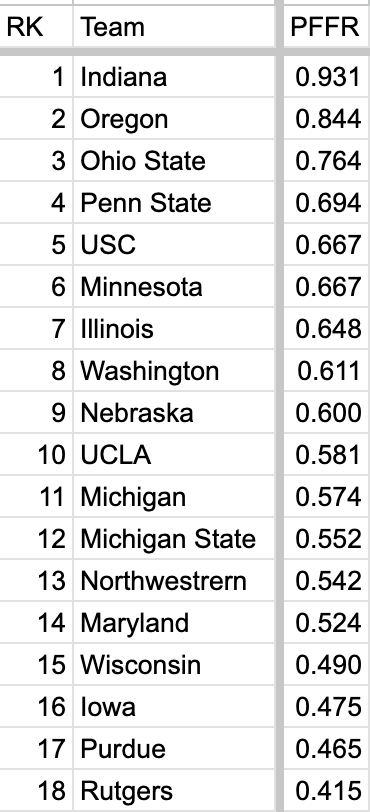
Is the methodology flawless? Of course not! (We can already hear the Michigan and Iowa fans complaining). Is it a fun, more wholesale look at a team than just last year’s results? We think so!
We took the PFFR scores, added them up as “points” on each team’s schedule, adjusted for home field, and gave a bonus for non-conference challenges to finalize our schedule rankings. With that context, here’s are list from easiest to toughest.
18. Penn State Nittany Lions
Why they rank here: Matt Campbell will have a prime opportunity to make a big splash in year one. In addition to having one of the most experienced teams in the conference, Campbell’s debut non-conference slate does not include a P4 opponent and the Nittany Lions draw five of the bottom six teams in the league based on our PFFR metric.
Key Game/Stretch: Back-to-back games against USC (home) and Michigan (away) in mid-October will tell us if Campbell’s team has the chops to contend for the conference title in year one.
17. Indiana Hoosiers
Why they rank here: Indiana knows they don’t have to schedule to make a bowl anymore, right? All jokes aside, the non-conference slate once again does not include a P4 opponent, those games are often scheduled years in advance, but we couldn’t find something on the heels of a national championship? As for league play, the Hoosiers’ three toughest projected games (Ohio State, USC, and Minnesota) are all at home.
Key Game/Stretch: It would shock us at this point if Indiana does not start 7-0, but after that the stretch of Ohio State, at Michigan, Minnesota, USC (after a bye), and at Washington could get tricky.
16. Nebraska Cornhuskers
Why they rank here: While the Huskers’ conference slate is daunting, featuring matchups against Indiana, Oregon (away), and Ohio State, as well as Illinois (away) and Washington, Nebraska is yet another team that lacks a P4 non-conference opponent. The margins between 11 and 16 on this list are razor-thin, so that was enough to keep them lower.
Key Game/Stretch: Nebraska will face Indiana at home and travel to Oregon in back-to-back weeks in mid-October. Yikes.
15. Illinois Fighting Illini
Why they rank here: Finally! A P4 non-con game! It just comes against a Duke team the Illini handled last year that lost most of their production to the portal… In league play, Illinois will face Oregon and Ohio State (away), but also face seven of the bottom ten teams in terms of PFFR. Could this be the actual year Illinois makes a CFP run?
Key Game/Stretch: The most favorable aspect of Illinois’ schedule might be how spaced out the big games are, but they must avoid a hangover as they travel to Maryland the week after hosting Oregon.
14. Iowa Hawkeyes
Why they rank here: Iowa’s marquee non-conference game is, as usual, the Cy-Hawk game against rival Iowa State. In league play, the Hawkeyes avoid Indiana, Oregon, and Penn State, but face tricky road trips to Minnesota, Illinois, Washington, and Michigan.
Key Game/Stretch: Perhaps the three toughest games on the schedule are back-to-back-to-back in late September and early October: at Michigan, Ohio State, and at Washington.
13. Wisconsin Badgers
Why they rank here: Badger fans have to be relieved to see their team ranked this low on the list after the gauntlet that was 2025. While they will face Notre Dame, who has a good chance to be ranked preseason number one, at Lambeau to open the season, the Badgers will avoid Indiana, Oregon, Ohio State, and Michigan this season.
Key Game/Stretch: October ends with the Badgers making a trip to UCLA, hosting USC, and going to Kinnick Stadium to battle the Hawkeyes. Luke Fickell’s job prospects will likely rest on the results of these three games.
12. USC Trojans
Why they rank here: There’s no denying that USC will be challenged in league play, facing Indiana and Penn State on the road while welcoming Ohio State and Oregon to the Coliseum. But the vacuum in the Trojans’ non-conference schedule left by the cancelation of the series with Notre Dame leaves USC without a signature non-conference opponent, or even a complete schedule, at the moment.
Key Game/Stretch: How Lincoln Riley’s squad handles the three-week run of Oregon, Washington, and Penn State (away) will tell us if we need to pay attention to later big-time contests against Ohio State and Indiana.
11. Maryland Terrapins
Why they rank here: Maryland has the good fortune of avoiding Indiana and Oregon, but do face Ohio State and USC on the road while hosting Penn State. Additionally, the Terps have a new-look Virginia Tech squad on the non-conference schedule, and a visit to an upset-minded UConn bunch.
Key Game/Stretch: Starting off strong with wins over UConn, Virginia Tech, and UCLA would be key for Mike Locksley as he looks to win his way off the hot seat in 2026.
10. Minnesota Golden Gophers
Why they rank here: P.J. Fleck will certainly have moments where he has to row the boat uphill with the three games that project to be the toughest on the Gophers’ schedule (Indiana, Penn State, and Washington) all on the road. On the flip side, they have a winnable home non-conference matchup against Mississippi State and also draw six of the bottom nine teams in the Big Ten according to our PFFR metric.
Key Game/Stretch: The Gophers begin their closing stretch out of a bye with a home date against Iowa and a road trip to Indiana before hosting UCLA and traveling to Penn State. As the calendar turns to November, it will be make or break time for a squad looking to move up the conference pecking order.
9. Oregon Ducks
Why they rank here: Like Minnesota, the Ducks’ three toughest games on paper (Ohio State, USC, and Illinois) will all be on the road. Unlike the Gophers, the Ducks will not face any team ranked in the bottom five according to PFFR. While the “marquee” non-conference game is a trip to Stillwater to face Oklahoma State, the opener against Boise at home could present a bigger challenge.
Key Game/Stretch: The Ducks will save their defining stretch for the last four weeks of the season, a closing gauntlet where they visit Columbus, host Michigan, and have a trap game scenario at Michigan State before closing the regular season back home against Washington.
8. Rutgers Scarlet Knights
Why they rank here: If you’ve ever dreamt of being a Rutgers season ticket holder, this is the season to jump in. With home dates against USC, Indiana, Michigan, and Nebraska, even if the Scarlet Knights struggle you should be able to find more than willing buyers on the secondary market. As a bonus, Rutgers will not leave the eastern seaboard until Oct. 17, and does not have a dreaded body clock game on the west coast this season.
Key Game/Stretch: Before the bye week on Oct. 10, Rutgers hosts USC and Indiana with a buy-game against Howard sandwiched in the middle. There will be no time to ease into the Big Ten schedule for the Scarlet Knights.
7. UCLA Bruins
Why they rank here: UCLA does not face the toughest conference slate, but their tricky non-conference trio is highlighted by a trip to a resurgent Cal on opening weekend, followed immediately by hosting San Diego State. Once Big Ten play begins in earnest, the Bruins will face road challenges at Oregon, Minnesota, and Michigan, as well as a coast-to-coast trip to Maryland.
Key Game/Stretch: Bob Chesney will need to stack up wins in the opening portion of the schedule to make a splash in year one. In addition to the two opening games mentioned above, a home game against Purdue and the trip to Maryland will be key to getting the Bruins back to a bowl game for the first time since 2023.
6. Michigan State Spartans
Why they rank here: Michigan State fared relatively well in the Big Ten schedule lottery, with a game against Oregon being the only opponent they will face in the top six according to our PFFR metric. They will, however, travel to South Bend on Sept. 19 to face the Fighting Irish and will have to defend home turf against Nebraska, Illinois, and Washington in addition to the Ducks.
Key Game/Stretch: Even if Pat Fitzgerald is able to navigate the first two months of his tenure in East Lansing relatively unscathed, November will be a brutal end to year one. The Spartans will travel to rival Michigan, host Washington and Oregon, and visit Piscataway to close out the regular season.
5. Washington Huskies
Why they rank here: The Huskies face five of the top six teams in the Big Ten according to or PFFR metric, and must also stave off upset-minded Wazzu in the season opener.
Key Game/Stretch: Speaking of brutal closes to the season, after a bye week on Oct. 24, the final five games on the Huskies’ schedule are Nebraska (away), Penn State, Michigan State (away), Indiana, and Oregon (away). Demond Williams and co. will have their work cut out for them!
4. Northwestern Wildcats
Why they rank here: Someone at the Big Ten office must be an Illinois fan. The Wildcats will play six of the top seven teams in our PFFR metric, and four of those games, including the top three (Indiana, Oregon, and Ohio State) are on the road. Throw in a non-conference game against Colorado and you get a daunting slate for the first year in a new stadium. Oh, and their bye week is in Week Two, meaning they will close the season with eleven straight games.
Key Game/Stretch: We’ll continue the closing stretch theme here with another doozy: Northwestern will travel to Eugene on Halloween, host Iowa, and go to Ohio State and Minnesota before closing out the schedule against rival Illinois at home.
3. Michigan Wolverines
Why they rank here: After so much offseason turmoil, any schedule, no matter how brutal, will be a welcome site for the Wolverines. Kyle Whittingham’s inaugural season in Ann Arbor will be a gauntlet, highlighted by road trips to Oregon and Ohio State and home dates with Indiana, Penn State, and SEC foe Oklahoma.
Key Game/Stretch: Back-to-back home games against Penn State and Indiana at the midway point of the season will help determine if the Wolverines are true contenders in 2026.
2. Ohio State Buckeyes
Why they rank here: After years of dealing with accusations of a soft schedule from folks in the southern part of the country, Ohio State indisputably has one of the toughest in the nation in 2026. The Buckeyes will visit Texas, Iowa, Indiana, USC, and Nebraska, while hosting Illinois, Oregon, and Michigan.
Key Game/Stretch: In a four-week stretch in late October and early November, Ohio State will travel to Indiana and USC (after a bye) and return home to face Oregon. Get busy living or get busy dying.
1. Purdue Boilermakers
Why they rank here: Purdue…we want to feel sorry for you because you have to go to Indiana and Penn State this year, but you know you didn’t have to make it this difficult on yourselves, right?! In addition to the Big Ten schedule, Purdue will host in-state foe Notre Dame and host a second power non-conference opponent in Wake Forest.
Key Game/Stretch: Notre Dame, at Illinois, Minnesota, and Washington leading up to the bye on Oct. 24 will likely have even the most devout Purdue fans excited to see what Matt Painter has on the hardwood in 2026-27.
Thanks for reading! Make sure to follow the show on your podcasting platform of choice, and be on the lookout for more great content to get you through the offseason!